


In the world of machine shops, accuracy and precision are fundamental elements to guarantee the quality and reliability of finished products. Among the essential tools that help achieve these goals, gauge blocks occupy a prominent place. Although these tools may seem simple in their design, they are in fact the result of sophisticated engineering and meticulous workmanship that makes them indispensable for a wide range of industrial applications.
What are gauge blocks?
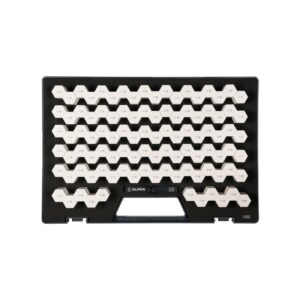
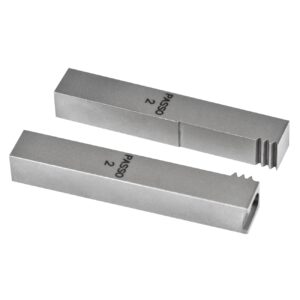
Calibration blocks, also known as gauge blocks, are high-precision measuring instruments used to calibrate and verify the accuracy of other measuring instruments. Usually made of hardened steel, ceramic or tungsten carbide, these blocks are ground and lapped with extreme precision to obtain perfectly flat and parallel surfaces. Their main feature is their ability to provide an exact measurement, which can be used as a reference to calibrate other instruments.
Use and applications of gauge blocks
In machine shops, gauge blocks are used in numerous applications. They are used to calibrate measuring instruments such as micrometers, gauges and dial gauges. They are also used to check the flatness and parallelity of machined surfaces, as well as to perform precision measurements during quality control. Their versatility also makes them suitable for constructing customised measuring instruments by assembling several blocks to obtain the desired length.
Advantages of using gauge blocks
The use of gauge blocks offers numerous advantages. First of all, they guarantee high measurement accuracy, which is essential for maintaining high quality standards. Furthermore, their durability and resistance to wear make them a long-term investment for machine shops. The possibility of combining different blocks to obtain customised measurements increases their flexibility and usefulness in different applications. Finally, the use of gauge blocks helps reduce measurement errors, improving efficiency and overall productivity.
Materials and production techniques
The choice of material for gauge blocks is crucial to ensure their accuracy and durability. Hardened steel is commonly used for its strength and dimensional stability. However, for applications requiring greater resistance to wear and corrosion, materials such as tungsten carbide or ceramic are preferred. The production of striker blocks involves extremely precise grinding and lapping processes, which ensure perfectly smooth surfaces and exact dimensions.
Frequently Asked Questions on Striker Blocks
1. How are the gauge blocks maintained?
Maintenance of the gauge blocks is essential to preserve their precision. It is important to clean them regularly with a soft, dry cloth to remove dust and debris. They should also be stored in a dry, moisture-free environment to prevent corrosion.
2. What is the difference between steel and ceramic striker blocks?
Steel blocks are cheaper and offer good wear resistance, but can be subject to corrosion. Ceramic blocks, on the other hand, are more resistant to corrosion and wear, but are more fragile and expensive.
3. How are gauge blocks used to calibrate a micrometer?
To calibrate a micrometer, a strike block of the desired size is selected and placed between the measuring surfaces of the micrometer. It is then checked that the micrometer reading exactly matches the block measurement. Any discrepancies indicate the need for an adjustment of the micrometer.
Conclusions
Measuring blocks are a key element in ensuring the accuracy and reliability of measurements in machine shops. Their ability to provide exact measurements and their versatility make them indispensable tools for a wide range of applications. Investing in high-quality gauge blocks means investing in the quality and efficiency of production processes, helping to maintain high standards of accuracy and reliability.
Showing 25–26 of 26 results